
A new form factor for delivery bags that tripled order capacity
Period
April — June 2019
Company
Samokat, instant grocery delivery
Users
Delivery couriers and order pickers
Role
Product Designer
Summary
What began as a project to improve delivery efficiency ultimately resulted in an innovative industrial design solution: to increase capacity and reduce delivery costs, I designed the modular delivery bags with a multi-tier structure and dividers that made loading and unloading faster while protecting products in transit. I also made the concept feasible for production by sourcing off-the-shelf containers that matched our dimensions. The final design was compact, comfortable to carry, and suitable for use on any mode of transport.
3×
lower delivery costs
30–40 kg
maximum load capacity
Context
Couriers’ core tasks include loading, transporting, and identifying several customer orders at once—often on the move and in bad weather. In the pilot stage, with just five dark stores, the existing courier bags were sufficient. But as the service began scaling rapidly in 2019, the bags were no longer fit for fast, multi-order delivery. Bulky items didn’t fit, temperature control was unreliable, orders were hard to identify, and the straps caused physical strain and injuries—ultimately slowing deliveries and increasing costs.
Goal
Our goal was to reduce delivery costs and speed up high-frequency tasks by increasing usable capacity, while also improving ergonomics for couriers and ensuring reliable temperature control.
Discovery
During the pilot period, couriers used soft fabric bags that could be worn on the back with two straps or slung over one shoulder. I needed to gather user feedback and propose an improved solution.
Research
I made several on-site visits to dark stores and conducted field observations of how orders are picked and packed and how couriers use the bags. Key insights:
- Some warehouses use an addressing system: shelves holding orders ready for delivery are labeled with the street addresses within the service area.
- When pickers place multiple orders for different customers in a single bag, they stick address labels on the packages so the courier can identify the order at handover to the customer.
- During peak hours, when couriers are in a rush, they ask for orders to be loaded into the bags while they’re still wearing them, without taking them off.
Observing delivery bags in real conditions
I also identified the key pain points to address in the design:
- The bags are made of textile and don’t hold their shape when empty or partially filled. During picking, workers have to constantly straighten the grocery bags inside and prop up the sides.
- The fabric provides poor thermal insulation: in summer, frozen and chilled items can spoil during delivery—and in heavy rain water gets inside the bags.
- The bags’ size and footprint don’t accommodate bulky items—for example, a 30-egg pack, a watermelon, or a pack of diapers.
- The bag can be carried over the shoulder or on the back in a vertical position. In the former, the strap chafes couriers’ necks because they often carry several bags at once; in the latter, when the bag is tilted, delicate items (chips, greens, tomatoes) end up crushed.
Customer (user) journey map for order-picking
Concept
Samokat’s core principles are speed, mobility, and quality. Based on these principles, I defined the following criteria for the new bag:
- Strength and rigidity
- Capacity
- Flexibility for consolidation
- Thermal performance
- Ergonomics
- Comfort
Nesting principle
We decided to separate the bag’s two main functions: (1) secure packaging for groceries, and (2) combining multiple orders for an optimized delivery. To achieve this, we use two types of containers: an inner and an outer one.
The inner container holds the groceries themselves, so it needs to be primarily rigid while remaining lightweight and easy to handle. The outer container (bag) is used to combine several inner containers (bins); therefore it must be spacious, allow flexible consolidation of multiple orders, and be comfortable to carry during delivery.
If an order includes bulky items (e.g., a watermelon or a pack of diapers), the picker can skip the inner container and pack those items directly into the outer one.
Numbering
To simplify order identification, a previous designer suggested placing orders into pre-numbered bags (or bins). This way, pickers wouldn’t have to write addresses on each package, which speeds up picking.
Because every second counts during picking, I added barcodes to the bin-number stickers: instead of typing digits, the picker scans the code, the system recognizes it, and the bin numbers appear on screen. During delivery, the courier sees in the app which numbers to hand off at each address.
I still had to decide on timing: scan the numbers at the start or at the end of picking. Entering numbers upfront would require the picker to estimate how many bins the order will fill—adding cognitive load and risking errors and rework. I therefore chose the second option: once all items are picked, the picker scans only the bins that are actually filled.
Multi-level structure
In a classic delivery bag, the flap is on top and grocery bags are stacked vertically. To keep lower orders from being crushed by the weight above, I added horizontal dividers and applied the “drawer” principle: items go into bins that are stacked one above another. Each bin not only rests on the one below but is also supported by a divider attached to the bag’s vertical walls, which distributes weight more evenly.
Multi-Level bin stacking
Empirically, I determined the maximum bag dimensions: width 50 cm, height 60 cm, and depth 30 cm. Anything larger would be too bulky for an average-sized person and would limit mobility. The bag had to fit at least three bins to carry two to three orders. Allowing a couple of centimeters of clearance within those outer dimensions, I calculated the approximate size of the inner module.
Sizing the bag for capacity and mobility
Prototyping
To pin down the exact module size, I selected several candidate dimensions and built cardboard prototypes of bins in different sizes. For testing, the product manager and I went to the busiest dark store: using the picking app, we pulled yesterday’s orders and, one by one, packed them into boxes of various sizes.
Validating bin dimensions with real orders
We tested the prototypes on 43 orders, most of which were small and contained two to four items:
- A height of 14 cm was too small, and some orders didn’t fully fit into such boxes.
- One order (number 27) included a 19-liter water bottle that didn’t fit into any of our boxes—we excluded this order from the analysis.
- One order (number 27) included a 19-liter water bottle that didn’t fit into any of our boxes—we excluded this order from the analysis.
- Aside from the 19-liter bottle order, one more order didn’t fit into boxes sized 46×16 and 46×20.
- Boxes sized 52×16 and 52×20 accommodated all orders except the one with the 19-liter bottle.
We tested boxes with widths from 40 to 52 cm and heights from 14 to 20 cm, with a fixed depth of 30 cm. ❌ — the order did not fit into the box. Order 27 contained a 19-liter bottle that didn’t fit into any box.
Design
Sourcing and testing bins
Our team chose a 46×16 cm module size as the optimal trade-off: it accommodated 97.7% of test orders without making the bag too bulky to carry. We also wanted the bins to nest when empty to save space in the dark store.
Choosing the final bin module dimensions
To quickly validate the bag construction on real orders, I went looking for off-the-shelf plastic bins that matched our target size. In a housewares store I found almost the right one, made of durable, lightweight polypropylene. They were slightly larger than we wanted, so I adjusted the bag size accordingly. For testing, I loaded the bins with glass and metal jars and simulated sharp maneuvers—turns, acceleration, braking. Nothing broke.
Bag layout
Inside the bag, bins were stacked vertically. We needed to decide where to place the flap. I wanted couriers to be able to retrieve any order without unloading the rest—giving them flexibility to plan routes and adjust on the fly. Instead of placing the flap on top, as in typical delivery bags, I put it on the front panel. This lets couriers quickly load and remove bins from the side without taking out the others.
Designing for flexible order retrieval
Manufacturing requirements
The bag needed weather protection, so we chose a water-repellent outer shell. To maintain a stable internal temperature, we added a layer of thermal insulation. For a tight seal, we used a combined closure: zippers along the sides of the flap and a hook-and-loop fastener on top. The back panel—which rests against the courier’s back and, together with the straps, bears most of the load—was reinforced with soft padding.
Manufacturing
Pilot samples
We found several manufacturers who could sew test prototypes. The first sample turned out too wide; when worn, it restricted arm movement. The materials used also didn’t meet our water-resistance requirements.
First and second prototype samples
We consulted with business stakeholders about removing one module to reduce the bag’s size and tried that configuration with another manufacturer. The second sample was too short in height, and the bag tipped on the wearer’s back even with a minimal load.
Final design
Based on the two rounds of testing, I defined the bag’s maximum and minimum dimensions. We did, however, like the materials from the second sample and decided to use them for a third iteration. The third sample proved the most successful.
Third iteration: final bag design
The whole team—including our business stakeholders—were happy with the third sample and eager to test it with real users. We ordered a small batch from the manufacturer to pilot the new bags in several dark stores.
Refinements in later versions
The pilot launch was successful. Loading and unloading bins was easy, the bags held three times more orders, and they remained light and much more comfortable to wear than their predecessors.
Field feedback driving design improvements
During the pilot, I visited dark stores frequently and gathered user feedback. Key issues were:
- The top rain-guard flap slowed loading/unloading because the hook-and-loop (Velcro) fastener was hard to detach.Fix: Repositioned the hook-and-loop by stitching it into the bag flap and moving it to the top edge instead of the side.
- Reflective elements weren’t large or visible enough.Fix: Increased the size and number of reflective elements and placed them around the backpack’s perimeter.
- Bins didn’t fit snugly against the bag walls and moved around during delivery.Fix: Reduced the bag’s width and depth by a couple of centimeters so the walls fit the inner containers more tightly.
Final design on city streets
Outcome
Replacing soft fabric bags with rigid, durable bags made it possible to carry loads of 30–40 kg and fit three times as many orders while keeping a compact form factor.
Switching to plastic bins allowed us to pilot bagless delivery. Due to COVID-era sanitation requirements, we ultimately discontinued that option. The rigid construction, however, enabled contactless handoff: couriers placed the binoxxs on top of the bag, and customers picked up their orders.
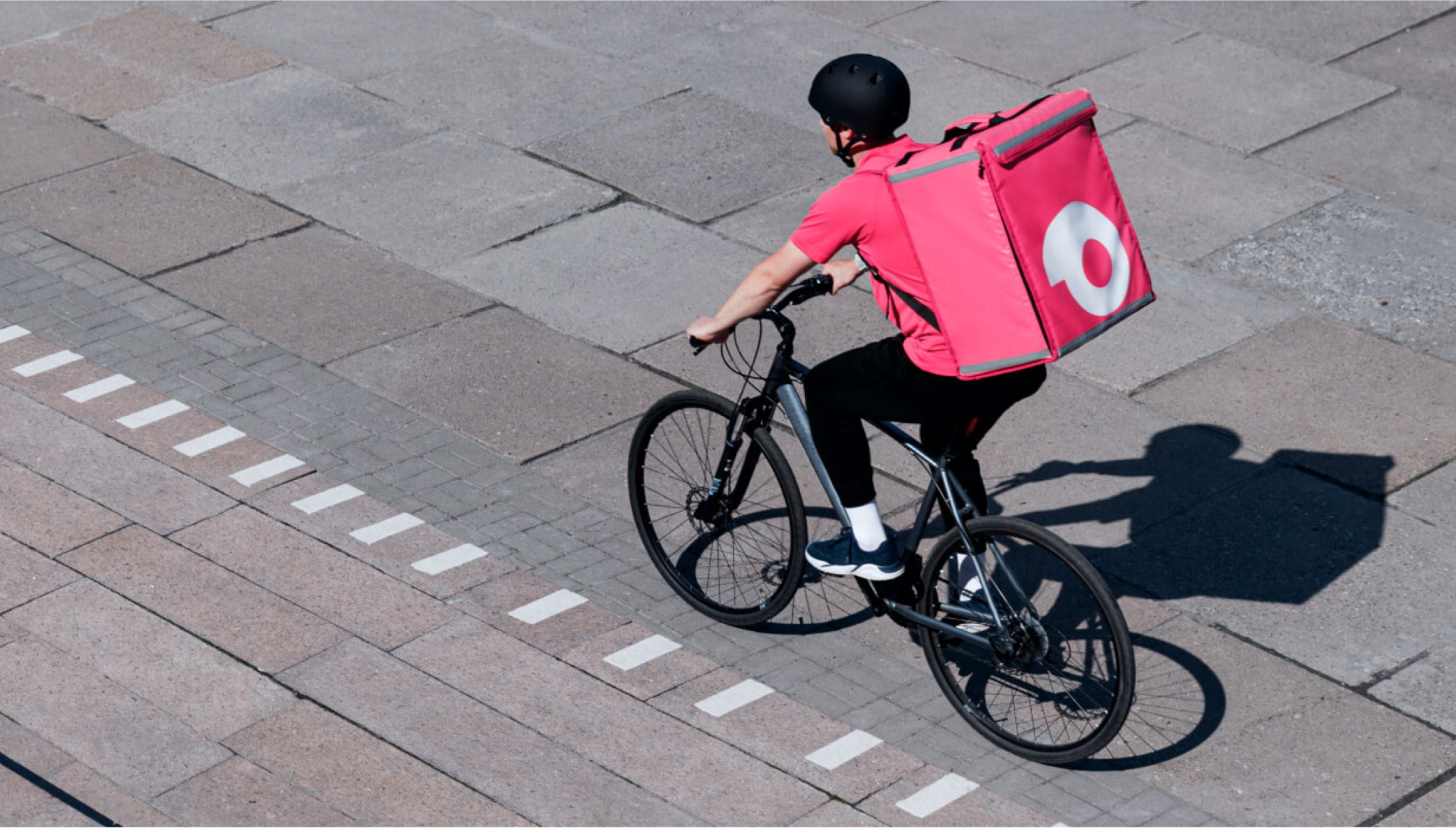
As a result, not only delivery became more efficient and convenient, but the courier bag also became part of the urban landscape: the pink bags appeared in ads, music videos, and at concerts. In late 2024, photos of pets in a limited-edition series of mini-bags went viral on social media.
Explore more projects
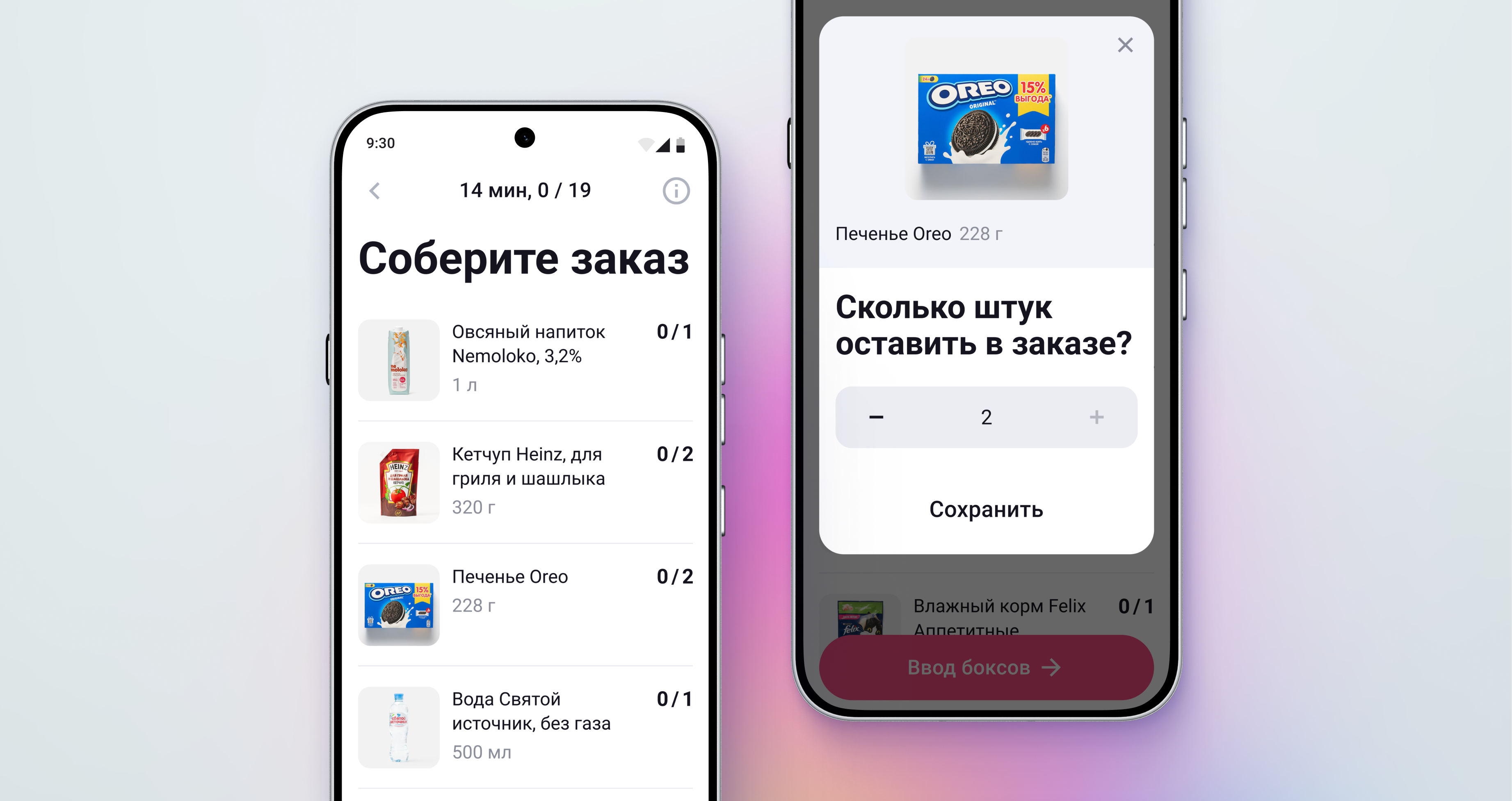
An app that made store operations faster and helped the business scale
Samokat delivery and store operations app
Read case study
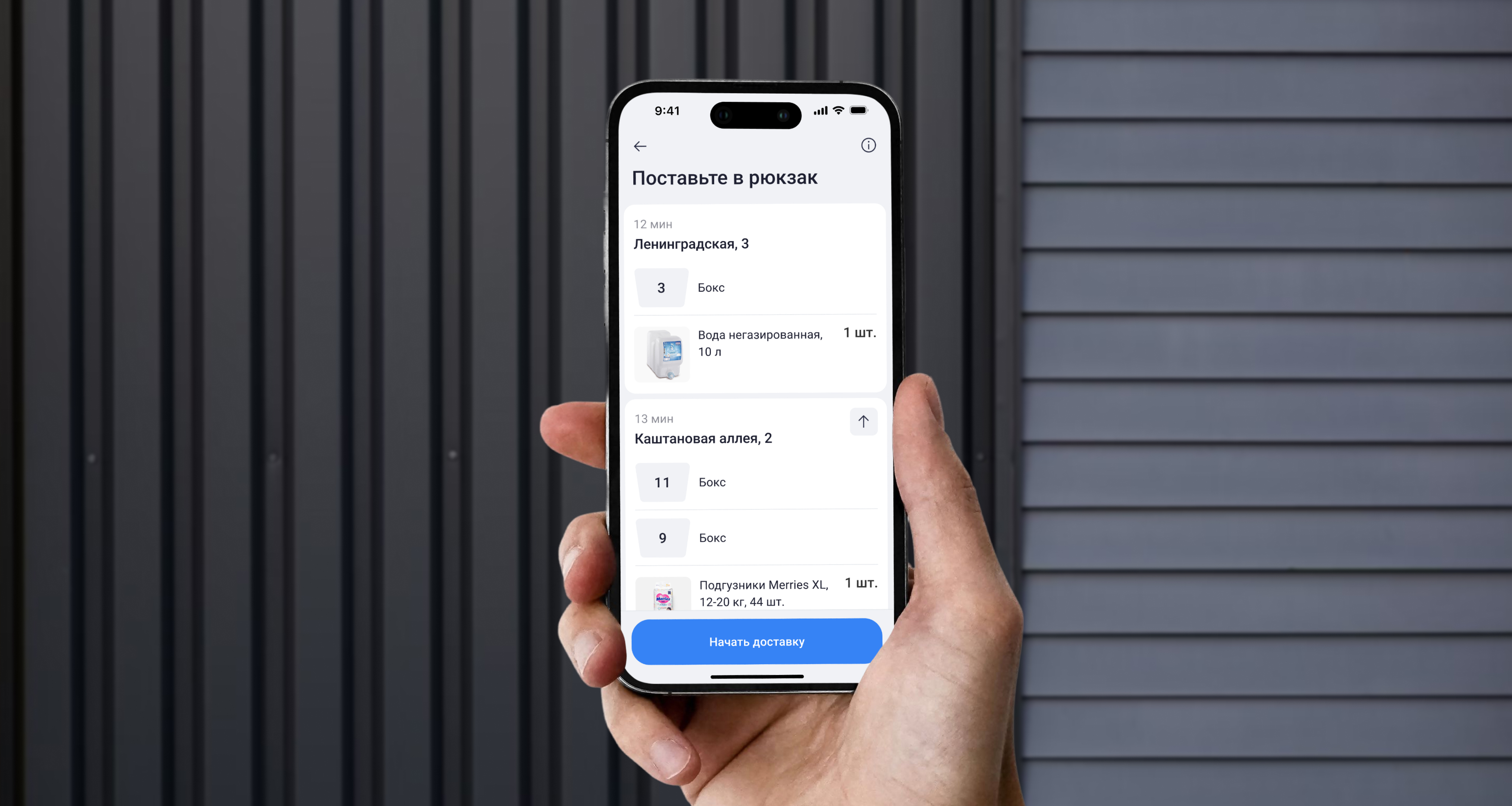
A React Native migration that expanded the hiring funnel by 32%
New app for iOS for Samokat dark-stores
Read case study
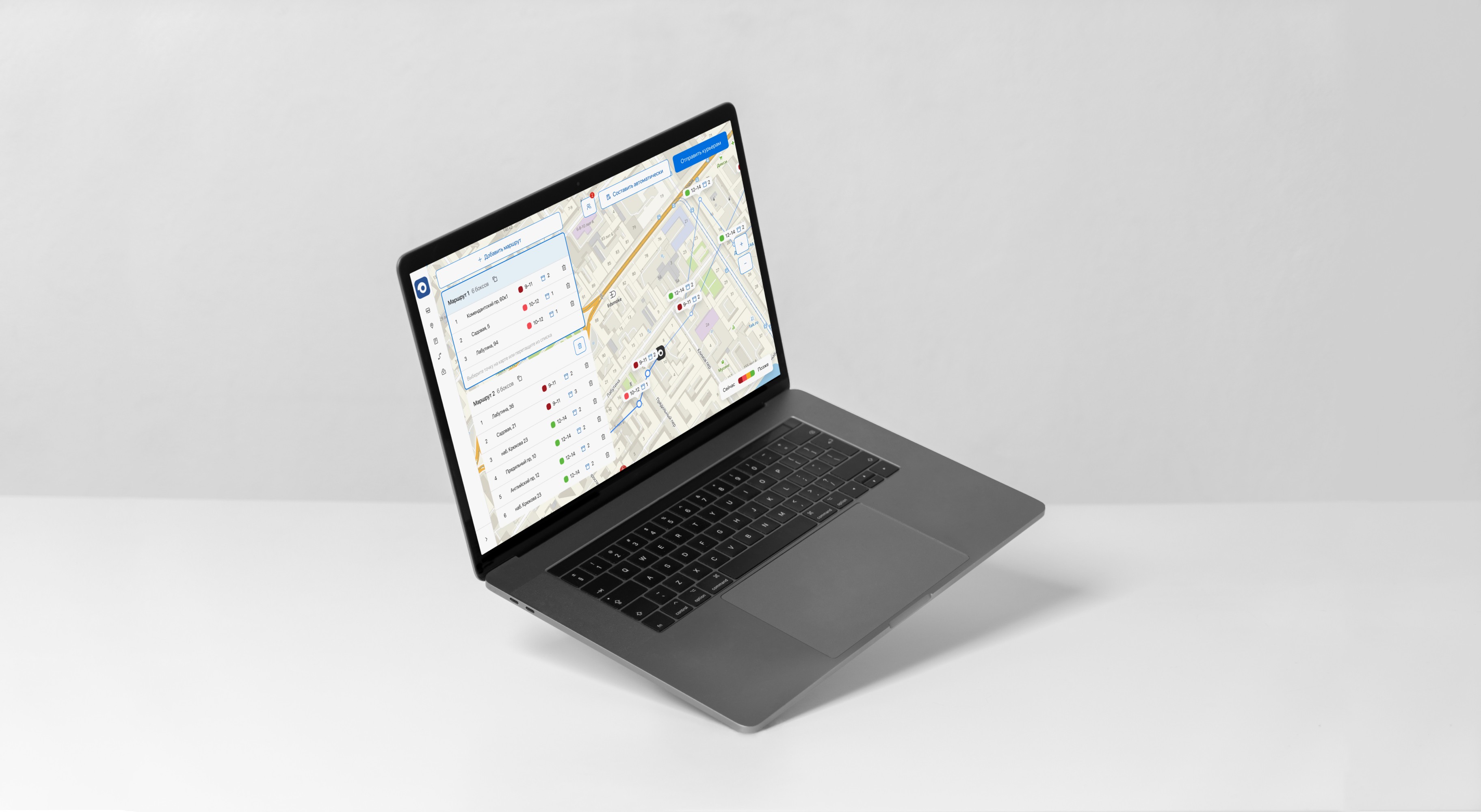
A web route-planning interface that cut planning time by 40x
Route planning web tool for Samokat
Read case study
A new form factor for delivery bags that tripled order capacity
Period
April — June 2019
Company
Samokat, instant grocery delivery
Users
Delivery couriers and order pickers
Role
Product Designer
Summary
What began as a project to improve delivery efficiency ultimately resulted in an innovative industrial design solution: to increase capacity and reduce delivery costs, I designed the modular delivery bags with a multi-tier structure and dividers that made loading and unloading faster while protecting products in transit. I also made the concept feasible for production by sourcing off-the-shelf containers that matched our dimensions. The final design was compact, comfortable to carry, and suitable for use on any mode of transport.
3×
lower delivery costs
30–40 kg
maximum load capacity
Context
Couriers’ core tasks include loading, transporting, and identifying several customer orders at once—often on the move and in bad weather. In the pilot stage, with just five dark stores, the existing courier bags were sufficient. But as the service began scaling rapidly in 2019, the bags were no longer fit for fast, multi-order delivery. Bulky items didn’t fit, temperature control was unreliable, orders were hard to identify, and the straps caused physical strain and injuries—ultimately slowing deliveries and increasing costs.
Goal
Our goal was to reduce delivery costs and speed up high-frequency tasks by increasing usable capacity, while also improving ergonomics for couriers and ensuring reliable temperature control.
Discovery
During the pilot period, couriers used soft fabric bags that could be worn on the back with two straps or slung over one shoulder. I needed to gather user feedback and propose an improved solution.
Research
I made several on-site visits to dark stores and conducted field observations of how orders are picked and packed and how couriers use the bags. Key insights:
- Some warehouses use an addressing system: shelves holding orders ready for delivery are labeled with the street addresses within the service area.
- When pickers place multiple orders for different customers in a single bag, they stick address labels on the packages so the courier can identify the order at handover to the customer.
- During peak hours, when couriers are in a rush, they ask for orders to be loaded into the bags while they’re still wearing them, without taking them off.
Observing delivery bags in real conditions
I also identified the key pain points to address in the design:
- The bags are made of textile and don’t hold their shape when empty or partially filled. During picking, workers have to constantly straighten the grocery bags inside and prop up the sides.
- The fabric provides poor thermal insulation: in summer, frozen and chilled items can spoil during delivery—and in heavy rain water gets inside the bags.
- The bags’ size and footprint don’t accommodate bulky items—for example, a 30-egg pack, a watermelon, or a pack of diapers.
- The bag can be carried over the shoulder or on the back in a vertical position. In the former, the strap chafes couriers’ necks because they often carry several bags at once; in the latter, when the bag is tilted, delicate items (chips, greens, tomatoes) end up crushed.
Customer (user) journey map for order-picking
Concept
Samokat’s core principles are speed, mobility, and quality. Based on these principles, I defined the following criteria for the new bag:
- Strength and rigidity
- Capacity
- Flexibility for consolidation
- Thermal performance
- Ergonomics
- Comfort
Nesting principle
We decided to separate the bag’s two main functions: (1) secure packaging for groceries, and (2) combining multiple orders for an optimized delivery. To achieve this, we use two types of containers: an inner and an outer one.
The inner container holds the groceries themselves, so it needs to be primarily rigid while remaining lightweight and easy to handle. The outer container (bag) is used to combine several inner containers (bins); therefore it must be spacious, allow flexible consolidation of multiple orders, and be comfortable to carry during delivery.
If an order includes bulky items (e.g., a watermelon or a pack of diapers), the picker can skip the inner container and pack those items directly into the outer one.
Numbering
To simplify order identification, a previous designer suggested placing orders into pre-numbered bags (or bins). This way, pickers wouldn’t have to write addresses on each package, which speeds up picking.
Because every second counts during picking, I added barcodes to the bin-number stickers: instead of typing digits, the picker scans the code, the system recognizes it, and the bin numbers appear on screen. During delivery, the courier sees in the app which numbers to hand off at each address.
I still had to decide on timing: scan the numbers at the start or at the end of picking. Entering numbers upfront would require the picker to estimate how many bins the order will fill—adding cognitive load and risking errors and rework. I therefore chose the second option: once all items are picked, the picker scans only the bins that are actually filled.
Multi-level structure
In a classic delivery bag, the flap is on top and grocery bags are stacked vertically. To keep lower orders from being crushed by the weight above, I added horizontal dividers and applied the “drawer” principle: items go into bins that are stacked one above another. Each bin not only rests on the one below but is also supported by a divider attached to the bag’s vertical walls, which distributes weight more evenly.
Multi-Level bin stacking
Empirically, I determined the maximum bag dimensions: width 50 cm, height 60 cm, and depth 30 cm. Anything larger would be too bulky for an average-sized person and would limit mobility. The bag had to fit at least three bins to carry two to three orders. Allowing a couple of centimeters of clearance within those outer dimensions, I calculated the approximate size of the inner module.
Sizing the bag for capacity and mobility
Prototyping
To pin down the exact module size, I selected several candidate dimensions and built cardboard prototypes of bins in different sizes. For testing, the product manager and I went to the busiest dark store: using the picking app, we pulled yesterday’s orders and, one by one, packed them into boxes of various sizes.
Validating bin dimensions with real orders
We tested the prototypes on 43 orders, most of which were small and contained two to four items:
- A height of 14 cm was too small, and some orders didn’t fully fit into such boxes.
- One order (number 27) included a 19-liter water bottle that didn’t fit into any of our boxes—we excluded this order from the analysis.
- One order (number 27) included a 19-liter water bottle that didn’t fit into any of our boxes—we excluded this order from the analysis.
- Aside from the 19-liter bottle order, one more order didn’t fit into boxes sized 46×16 and 46×20.
- Boxes sized 52×16 and 52×20 accommodated all orders except the one with the 19-liter bottle.
We tested boxes with widths from 40 to 52 cm and heights from 14 to 20 cm, with a fixed depth of 30 cm. ❌ — the order did not fit into the box. Order 27 contained a 19-liter bottle that didn’t fit into any box.
Design
Sourcing and testing bins
Our team chose a 46×16 cm module size as the optimal trade-off: it accommodated 97.7% of test orders without making the bag too bulky to carry. We also wanted the bins to nest when empty to save space in the dark store.
Choosing the final bin module dimensions
To quickly validate the bag construction on real orders, I went looking for off-the-shelf plastic bins that matched our target size. In a housewares store I found almost the right one, made of durable, lightweight polypropylene. They were slightly larger than we wanted, so I adjusted the bag size accordingly. For testing, I loaded the bins with glass and metal jars and simulated sharp maneuvers—turns, acceleration, braking. Nothing broke.
Bag layout
Inside the bag, bins were stacked vertically. We needed to decide where to place the flap. I wanted couriers to be able to retrieve any order without unloading the rest—giving them flexibility to plan routes and adjust on the fly. Instead of placing the flap on top, as in typical delivery bags, I put it on the front panel. This lets couriers quickly load and remove bins from the side without taking out the others.
Designing for flexible order retrieval
Manufacturing requirements
The bag needed weather protection, so we chose a water-repellent outer shell. To maintain a stable internal temperature, we added a layer of thermal insulation. For a tight seal, we used a combined closure: zippers along the sides of the flap and a hook-and-loop fastener on top. The back panel—which rests against the courier’s back and, together with the straps, bears most of the load—was reinforced with soft padding.
Manufacturing
Pilot samples
We found several manufacturers who could sew test prototypes. The first sample turned out too wide; when worn, it restricted arm movement. The materials used also didn’t meet our water-resistance requirements.
First and second prototype samples
We consulted with business stakeholders about removing one module to reduce the bag’s size and tried that configuration with another manufacturer. The second sample was too short in height, and the bag tipped on the wearer’s back even with a minimal load.
Final design
Based on the two rounds of testing, I defined the bag’s maximum and minimum dimensions. We did, however, like the materials from the second sample and decided to use them for a third iteration. The third sample proved the most successful.
Third iteration: final bag design
The whole team—including our business stakeholders—were happy with the third sample and eager to test it with real users. We ordered a small batch from the manufacturer to pilot the new bags in several dark stores.
Refinements in later versions
The pilot launch was successful. Loading and unloading bins was easy, the bags held three times more orders, and they remained light and much more comfortable to wear than their predecessors.
Field feedback driving design improvements
During the pilot, I visited dark stores frequently and gathered user feedback. Key issues were:
- The top rain-guard flap slowed loading/unloading because the hook-and-loop (Velcro) fastener was hard to detach.Fix: Repositioned the hook-and-loop by stitching it into the bag flap and moving it to the top edge instead of the side.
- Reflective elements weren’t large or visible enough.Fix: Increased the size and number of reflective elements and placed them around the backpack’s perimeter.
- Bins didn’t fit snugly against the bag walls and moved around during delivery.Fix: Reduced the bag’s width and depth by a couple of centimeters so the walls fit the inner containers more tightly.
Final design on city streets
Outcome
Replacing soft fabric bags with rigid, durable bags made it possible to carry loads of 30–40 kg and fit three times as many orders while keeping a compact form factor.
Switching to plastic bins allowed us to pilot bagless delivery. Due to COVID-era sanitation requirements, we ultimately discontinued that option. The rigid construction, however, enabled contactless handoff: couriers placed the binoxxs on top of the bag, and customers picked up their orders.
As a result, not only delivery became more efficient and convenient, but the courier bag also became part of the urban landscape: the pink bags appeared in ads, music videos, and at concerts. In late 2024, photos of pets in a limited-edition series of mini-bags went viral on social media.
Explore more projects
An app that made store operations faster and helped the business scale
Samokat delivery and store operations app
Read case study
A React Native migration that expanded the hiring funnel by 32%
New app for iOS for Samokat dark-stores
Read case study
A web route-planning interface that cut planning time by 40x
Route planning web tool for Samokat
Read case study
A new form factor for delivery bags that tripled order capacity
Period
April — June 2019
Company
Samokat, instant grocery delivery
Users
Delivery couriers and order pickers
Role
Product Designer
Summary
What began as a project to improve delivery efficiency ultimately resulted in an innovative industrial design solution: to increase capacity and reduce delivery costs, I designed the modular delivery bags with a multi-tier structure and dividers that made loading and unloading faster while protecting products in transit. I also made the concept feasible for production by sourcing off-the-shelf containers that matched our dimensions. The final design was compact, comfortable to carry, and suitable for use on any mode of transport.
3×
lower delivery costs
30–40 kg
maximum load capacity
Context
Couriers’ core tasks include loading, transporting, and identifying several customer orders at once—often on the move and in bad weather. In the pilot stage, with just five dark stores, the existing courier bags were sufficient. But as the service began scaling rapidly in 2019, the bags were no longer fit for fast, multi-order delivery. Bulky items didn’t fit, temperature control was unreliable, orders were hard to identify, and the straps caused physical strain and injuries—ultimately slowing deliveries and increasing costs.
Goal
Our goal was to reduce delivery costs and speed up high-frequency tasks by increasing usable capacity, while also improving ergonomics for couriers and ensuring reliable temperature control.
Discovery
During the pilot period, couriers used soft fabric bags that could be worn on the back with two straps or slung over one shoulder. I needed to gather user feedback and propose an improved solution.
Research
I made several on-site visits to dark stores and conducted field observations of how orders are picked and packed and how couriers use the bags. Key insights:
- Some warehouses use an addressing system: shelves holding orders ready for delivery are labeled with the street addresses within the service area.
- When pickers place multiple orders for different customers in a single bag, they stick address labels on the packages so the courier can identify the order at handover to the customer.
- During peak hours, when couriers are in a rush, they ask for orders to be loaded into the bags while they’re still wearing them, without taking them off.
Observing delivery bags in real conditions
I also identified the key pain points to address in the design:
- The bags are made of textile and don’t hold their shape when empty or partially filled. During picking, workers have to constantly straighten the grocery bags inside and prop up the sides.
- The fabric provides poor thermal insulation: in summer, frozen and chilled items can spoil during delivery—and in heavy rain water gets inside the bags.
- The bags’ size and footprint don’t accommodate bulky items—for example, a 30-egg pack, a watermelon, or a pack of diapers.
- The bag can be carried over the shoulder or on the back in a vertical position. In the former, the strap chafes couriers’ necks because they often carry several bags at once; in the latter, when the bag is tilted, delicate items (chips, greens, tomatoes) end up crushed.
Customer (user) journey map for order-picking
Concept
Samokat’s core principles are speed, mobility, and quality. Based on these principles, I defined the following criteria for the new bag:
- Strength and rigidity
- Capacity
- Flexibility for consolidation
- Thermal performance
- Ergonomics
- Comfort
Nesting principle
We decided to separate the bag’s two main functions: (1) secure packaging for groceries, and (2) combining multiple orders for an optimized delivery. To achieve this, we use two types of containers: an inner and an outer one.
The inner container holds the groceries themselves, so it needs to be primarily rigid while remaining lightweight and easy to handle. The outer container (bag) is used to combine several inner containers (bins); therefore it must be spacious, allow flexible consolidation of multiple orders, and be comfortable to carry during delivery.
If an order includes bulky items (e.g., a watermelon or a pack of diapers), the picker can skip the inner container and pack those items directly into the outer one.
Numbering
To simplify order identification, a previous designer suggested placing orders into pre-numbered bags (or bins). This way, pickers wouldn’t have to write addresses on each package, which speeds up picking.
Because every second counts during picking, I added barcodes to the bin-number stickers: instead of typing digits, the picker scans the code, the system recognizes it, and the bin numbers appear on screen. During delivery, the courier sees in the app which numbers to hand off at each address.
I still had to decide on timing: scan the numbers at the start or at the end of picking. Entering numbers upfront would require the picker to estimate how many bins the order will fill—adding cognitive load and risking errors and rework. I therefore chose the second option: once all items are picked, the picker scans only the bins that are actually filled.
Multi-level structure
In a classic delivery bag, the flap is on top and grocery bags are stacked vertically. To keep lower orders from being crushed by the weight above, I added horizontal dividers and applied the “drawer” principle: items go into bins that are stacked one above another. Each bin not only rests on the one below but is also supported by a divider attached to the bag’s vertical walls, which distributes weight more evenly.
Multi-Level bin stacking
Empirically, I determined the maximum bag dimensions: width 50 cm, height 60 cm, and depth 30 cm. Anything larger would be too bulky for an average-sized person and would limit mobility. The bag had to fit at least three bins to carry two to three orders. Allowing a couple of centimeters of clearance within those outer dimensions, I calculated the approximate size of the inner module.
Sizing the bag for capacity and mobility
Prototyping
To pin down the exact module size, I selected several candidate dimensions and built cardboard prototypes of bins in different sizes. For testing, the product manager and I went to the busiest dark store: using the picking app, we pulled yesterday’s orders and, one by one, packed them into boxes of various sizes.
Validating bin dimensions with real orders
We tested the prototypes on 43 orders, most of which were small and contained two to four items:
- A height of 14 cm was too small, and some orders didn’t fully fit into such boxes.
- One order (number 27) included a 19-liter water bottle that didn’t fit into any of our boxes—we excluded this order from the analysis.
- One order (number 27) included a 19-liter water bottle that didn’t fit into any of our boxes—we excluded this order from the analysis.
- Aside from the 19-liter bottle order, one more order didn’t fit into boxes sized 46×16 and 46×20.
- Boxes sized 52×16 and 52×20 accommodated all orders except the one with the 19-liter bottle.
We tested boxes with widths from 40 to 52 cm and heights from 14 to 20 cm, with a fixed depth of 30 cm. ❌ — the order did not fit into the box. Order 27 contained a 19-liter bottle that didn’t fit into any box.
Design
Sourcing and testing bins
Our team chose a 46×16 cm module size as the optimal trade-off: it accommodated 97.7% of test orders without making the bag too bulky to carry. We also wanted the bins to nest when empty to save space in the dark store.
Choosing the final bin module dimensions
To quickly validate the bag construction on real orders, I went looking for off-the-shelf plastic bins that matched our target size. In a housewares store I found almost the right one, made of durable, lightweight polypropylene. They were slightly larger than we wanted, so I adjusted the bag size accordingly. For testing, I loaded the bins with glass and metal jars and simulated sharp maneuvers—turns, acceleration, braking. Nothing broke.
Bag layout
Inside the bag, bins were stacked vertically. We needed to decide where to place the flap. I wanted couriers to be able to retrieve any order without unloading the rest—giving them flexibility to plan routes and adjust on the fly. Instead of placing the flap on top, as in typical delivery bags, I put it on the front panel. This lets couriers quickly load and remove bins from the side without taking out the others.
Designing for flexible order retrieval
Manufacturing requirements
The bag needed weather protection, so we chose a water-repellent outer shell. To maintain a stable internal temperature, we added a layer of thermal insulation. For a tight seal, we used a combined closure: zippers along the sides of the flap and a hook-and-loop fastener on top. The back panel—which rests against the courier’s back and, together with the straps, bears most of the load—was reinforced with soft padding.
Manufacturing
Pilot samples
We found several manufacturers who could sew test prototypes. The first sample turned out too wide; when worn, it restricted arm movement. The materials used also didn’t meet our water-resistance requirements.
First and second prototype samples
We consulted with business stakeholders about removing one module to reduce the bag’s size and tried that configuration with another manufacturer. The second sample was too short in height, and the bag tipped on the wearer’s back even with a minimal load.
Final design
Based on the two rounds of testing, I defined the bag’s maximum and minimum dimensions. We did, however, like the materials from the second sample and decided to use them for a third iteration. The third sample proved the most successful.
Third iteration: final bag design
The whole team—including our business stakeholders—were happy with the third sample and eager to test it with real users. We ordered a small batch from the manufacturer to pilot the new bags in several dark stores.
Refinements in later versions
The pilot launch was successful. Loading and unloading bins was easy, the bags held three times more orders, and they remained light and much more comfortable to wear than their predecessors.
Field feedback driving design improvements
During the pilot, I visited dark stores frequently and gathered user feedback. Key issues were:
- The top rain-guard flap slowed loading/unloading because the hook-and-loop (Velcro) fastener was hard to detach.Fix: Repositioned the hook-and-loop by stitching it into the bag flap and moving it to the top edge instead of the side.
- Reflective elements weren’t large or visible enough.Fix: Increased the size and number of reflective elements and placed them around the backpack’s perimeter.
- Bins didn’t fit snugly against the bag walls and moved around during delivery.Fix: Reduced the bag’s width and depth by a couple of centimeters so the walls fit the inner containers more tightly.
Final design on city streets
Outcome
Replacing soft fabric bags with rigid, durable bags made it possible to carry loads of 30–40 kg and fit three times as many orders while keeping a compact form factor.
Switching to plastic bins allowed us to pilot bagless delivery. Due to COVID-era sanitation requirements, we ultimately discontinued that option. The rigid construction, however, enabled contactless handoff: couriers placed the binoxxs on top of the bag, and customers picked up their orders.
As a result, not only delivery became more efficient and convenient, but the courier bag also became part of the urban landscape: the pink bags appeared in ads, music videos, and at concerts. In late 2024, photos of pets in a limited-edition series of mini-bags went viral on social media.
Explore more projects
An app that made store operations faster and helped the business scale
Samokat delivery and store operations app
Read case study
A React Native migration that expanded the hiring funnel by 32%
New app for iOS for Samokat dark-stores
Read case study
A web route-planning interface that cut planning time by 40x
Route planning web tool for Samokat
Read case study